๐Ÿ”‘ Making the Key

Key Generation in ML-KEMโ€‹


๐ŸŽฏ The Simple Storyโ€‹

Bob wants to receive secret messages from Alice.

He needs: A locked box (public key) that anyone can close + a special key (private key) only he can open.

Bob creates his lockbox like this:

  1. Bob creates a grid of instructions: Matrix A (from a tiny 32-byte seed)
  2. Bob picks a secret location: Secret s (small random coefficients)
  3. Bob adds fog: Error vectors e (small random coefficients)
  4. Bob marks the foggy location: Computes t = Aยทs + e
  5. Bob shares: Sends grid + foggy location (public key = A, t)
  6. Bob keeps: His secret location hidden (private key = s)

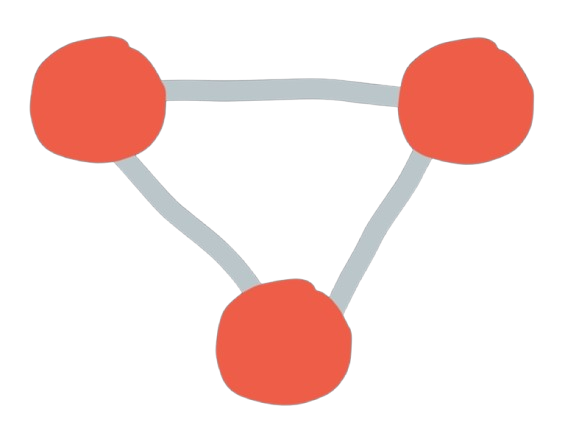
Eve sees: The grid (A) and the foggy location (t), but doesn't know which dot is Bob's secret!

Bob knows: His secret location (private key = s)

That's how ML-KEM generates keys - Bob creates a "foggy map" (public key) but keeps the "true location" (private key) secret!


๐Ÿง  Mental Modelโ€‹

Hold this picture in your head:

Bob's Key Generation:

Step 1: Bob creates matrix A
Public: 32-byte seed โ†’ PRG โ†’ matrix A (3ร—3 polynomials)

Step 2: Bob picks secret s
Secret: Small polynomials (coefficients -2 to 2)

Step 3: Bob adds error e
Error: Small polynomials (coefficients -2 to 2)

Step 4: Bob computes t
Compute: t = A*s + e (with mod 3329)

Step 5: Bob shares public key
Public key: (A, t) = 1,184 bytes
Private key: s = 64 bytes (kept secret!)

Think of it like:

๐Ÿ—บ๏ธ Scavenger hunt (Bob draws map, hides treasure, sends foggy map)

๐Ÿ“ฆ Lockbox (Bob makes box anyone can close, but only he can open)

๐ŸŽญ Disguise (Bob publishes puzzle, only he knows solution)


๐Ÿ“Š See It Happenโ€‹

Let's watch Bob generate keys:


๐ŸŽฎ Try It Yourselfโ€‹

Question 1: Bob creates matrix A with 3 polynomials (9 total). Each has 256 coefficients. What's the raw size if each is 12 bits?

Show Answer

Total coefficients: 3 ร— 256 = 768 coefficients

Raw bits: 768 ร— 12 = 9,216 bits

Raw bytes: 9,216 รท 8 = 1,152 bytes

Answer: 1,152 bytes raw (but compressed to 1,184 bytes in pk!)


Question 2: Bob's secret s is small coefficients โˆ’2 to +2. Why does Eve seeing (A, t) make it hard to find s?

Show Answer

Eve sees: Matrix A and vector t

Eve wants: Find secret s

Problem: Eve doesn't know error e!

Eve must solve: Aยทs + e = t

Two unknowns: s and e!

Eve can try: For every s, compute what e should be to match t

But s has: 5^256 possibilities (each coeff โˆ’2 to +2, 256 coeffs)

That's ~10^178 possibilities - more atoms than universe!

Answer: Too many (s, e) pairs possible, Eve can't find the true one!


Question 3: Why is Bob's secret s small coefficients (โˆ’2 to +2)? What if they were 0 to 3328 (full range)?

Show Answer this.

If s had full range (0 to 3328), Eve could still search all possibilities.

But Bob's advantage: He knows s exactly!

Bob's use case: He needs to decode during decapsulation

If s were huge, adding error e would sometimes cause failures (Bob can't recover correctly!)

Small s plus small e equals Bob can subtract Aยทs from t to find e, then recover message!

Answer: Small s equals Bob can use it for decoding, Eve still can't find it.


๐Ÿ”ข The Mathโ€‹

Key Generation Algorithmโ€‹

KeyGenerate():
1. Sample matrix A from seed
seed generates (using pseudo-random generator)
matrix A is a polynomial matrix in ring R_q

2. Sample secret vectors
s from Binomial(eta1)^k (small polynomials)
Each coefficient in set negative 2, 1, 0, 1, or 2
256 coefficients per polynomial, 3 polynomials total

3. Sample error vectors
e from Binomial(eta1)^k (small polynomials)
Each coefficient in negative 2, 1, 0, 1, or 2
256 coefficients per polynomial, 3 polynomials total

4. Compute public component
t = A*s + e (mod 3329)
Multiply matrix by vector in polynomial ring

5. Output keys
pk = (A, t) encoded as public key (1,184 bytes)
sk = s encoded as private key (64 bytes)

Return (pk, sk)

Parameter Values (ML-KEM768)โ€‹

SymbolValueMeaning
n256Polynomial degree
q3329Coefficient modulus
k3Matrix size = 3x3
eta12Key generation error parameter
pk size1,184 bytesA (864) plus t (320)
sk size64 bytess (encoded)

Matrix Expansion in Detailโ€‹

Given 32-byte seed S:

  1. Initialize PRG (pseudo-random generator) with seed S
  2. Generate 9 polynomials (each 256 coefficients)
  3. For each coefficient: Sample from uniform distribution mod 3329
  4. This creates matrix A in polynomial ring R_q

Total matrix size: 9 ร— 256 = 2,304 coefficients

Storage: Seed S is only 32 bytes (expand when needed!)


๐Ÿ’ก Why We Careโ€‹

Security: MLWE Hardnessโ€‹

Eve's problem: Given (A, t), find s

This is exactly MLWE: matrix multiplication plus unknown e is the hard puzzle!

Without e: Eve could solve using s = A^(-1)*t (easy linear algebra)

With e: Eve must find (s, e) from one equation, two unknowns (too hard!)

Complexity: about 2^256 operations (256-bit security)

Bob's Advantageโ€‹

Bob knows: s (he chose it)

When encrypting: Alice encapsulates using A and t

When decrypting: Bob computes: e = t - A*s

Bob can subtract out the noise Eve added!

Key Sizesโ€‹

ComponentRaw SizeEncoded Size
Matrix A3,456 bytes864 bytes
Vector t1,152 bytes320 bytes
Public key pk4,608 bytes1,184 bytes
Private key sk-64 bytes

Compression ratio: About 96% smaller (1,184 vs. 4,608 bytes)


โœ… Quick Checkโ€‹

Can you explain key generation to a 5-year-old?

Try saying this out loud:

"Bob wants to receive secret messages. He draws a grid, picks a secret spot, adds fog, marks the foggy location, and shares the grid plus mark. He keeps the real secret. The foggy mark is the public key, the secret spot is the private key!"

Can you work through key generation?

Try this examples:

Bob generates keys:

  1. Bob generates: 32-byte seed S
  2. Bob expands S โ†’ matrix A (9 polynomials)
  3. Bob samples: s = small random polynomials
  4. Bob samples: e = small random polynomials
  5. Bob computes: t = A*s + e (mod 3329)
  6. Output: pk = (A, t), sk = s

Answer: pk is public (shared), sk is secret (Bob keeps hidden).


๐Ÿ“‹ Key Takeawaysโ€‹

โœ… KeyGen steps: Sample A (seed), sample s/e, compute t, encode โœ… Public key: pk = (A, t) = 1,184 bytes (shared openly) โœ… Private key: sk = s = 64 bytes (kept secret!) โœ… Security: MLWE hardness: A*s + e = t (two unknowns!) โœ… Bob's advantage: Has s (knows e when needed) โœ… Key sizes: pk 1,184 bytes, sk 64 bytes (compressed) โœ… Matrix generation: 32-byte seed โ†’ 3,456 bytes (PRG expansion)


๐ŸŽ‰ What You'll Learn Nextโ€‹

Now you understand key generation! Next, we'll learn about:

๐Ÿ”’ Putting Secrets in Boxes โ†’ Encapsulation

How Alice encapsulates a random secret into ciphertext to send to Bob!